
 For decades, water fluoridation has been hailed as one of the greatest public health achievements of the 20th century. However, in recent years, it has become a flashpoint for debate. From social media threads to state legislatures, concerns have grown: Is the fluoride in our water supply harming our children’s developing brains?
A groundbreaking study published today in PNAS (Proceedings of the National Academy of Sciences) offers some of the most robust evidence to date regarding fluoride and cognitive health in the United States.
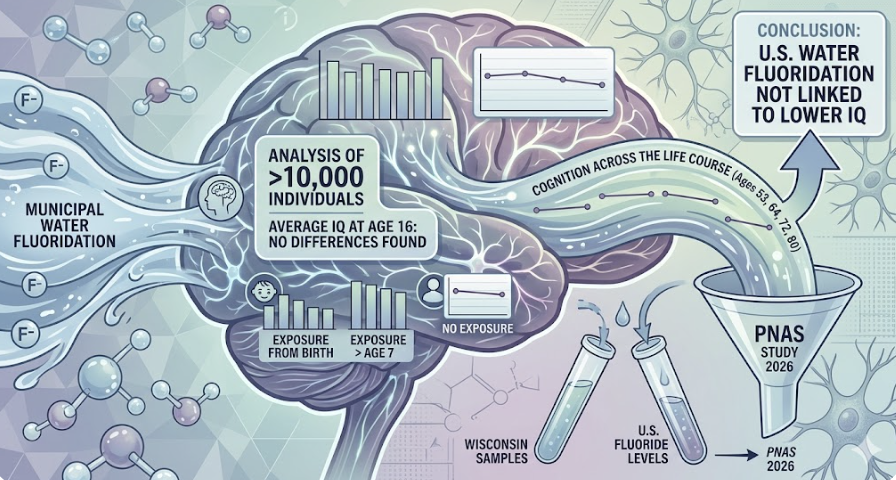
The verdict? Researchers found no link between U.S. levels of water fluoridation and lower IQ or cognitive decline.
Why the Debate is Heating Up
The controversy isn’t entirely without merit. Previous meta-analyses have suggested that early fluoride exposure could be detrimental to the brain. This has prompted several states to consider banning fluoride in their water supplies.
However, science is often about context. Many of the studies linking fluoride to lower IQ were conducted in other countries where fluoride levels in the drinking water are significantly higher than the regulated levels found in U.S. municipal systems.
The Wisconsin Longitudinal Study: 60 Years of Data
To get a clearer picture of how fluoride affects Americans over a lifetime, researchers analyzed data from the Wisconsin Longitudinal Study (WLS). This study followed 10,317 individuals who graduated from high school in 1957, tracking them for over six decades.
The researchers broke the participants into four distinct groups:
- Exposure from birth (natural fluoride from wells).
- Exposure after age 7 (when municipal fluoridation began).
- Exposure after age 14.
- No childhood exposure.
The Findings: A Clear Picture
After adjusting for sociodemographic factors and school environments, the results were remarkably consistent:
- No IQ Difference at Age 16: There were no differences in average IQ scores among the four groups during adolescence.
- Cognitive Health in Old Age: Researchers checked back in when the participants were 53, 64, 72, and 80 years old. Again, they found almost no fluoride-based differences in cognitive scores.
- Consistency Matters: Even when the researchers narrowed the data to “lifers”—people who lived in the same county their entire childhood to ensure consistent exposure—the results remained the same.
The Nuance: What We Don’t Know
While the study is massive in scale, the researchers noted a few limitations. The data measured whether participants lived in a community with fluoridated water, but it couldn’t track exactly how many glasses of water each person drank per day. It also didn’t account for other sources of fluoride, such as modern toothpastes or dental treatments, which weren’t as prevalent in the 1940s and 50s.
The Takeaway
Public health policy is often a tug-of-war between benefits and risks. While some studies have raised flags about prenatal exposure or extremely high concentrations of fluoride, this new data provides a reassuring long-term outlook for standard U.S. water fluoridation.
For policymakers and parents alike, this study adds a vital piece of the puzzle: in a large-scale, 60-year U.S. sample, the fluoride levels meant to protect our teeth did not come at the cost of our intelligence.
Source: Warren, J. R., et al. (2026). Municipal water fluoridation, adolescent IQ, and cognition across the life course: evidence from the Wisconsin Longitudinal Study. PNAS.
Come see any of our licensed Clinicians at our 5 locations. Click to learn more! https://hopeforyourbrain.com/
Synaptic Psych – Brentwood Clinic is located at 5300 Maryland Way Ste 103, Brentwood TN 37027 – Welcome to Synaptic Psych’s Brentwood clinic, where compassionate, cutting-edge mental health care meets the heart of Williamson County. We serve Brentwood, Nolensville, Antioch, and beyond!
Synaptic Psych – Franklin Clinic is located at 381 Riverside Dr Suite 460, Franklin, TN 37064 – Welcome to Synaptic Psych’s Brentwood clinic, where compassionate, cutting-edge mental health care meets the heart of Williamson County. We serve Brentwood, Nolensville, Antioch, and beyond! Our expert team of Brentwood Psychiatrists offers a full spectrum of behavioral health services
Synaptic Psych – Nashville Clinic is located at 2125 Belcourt Ave, Nashville, TN 37212. – Welcome to Synaptic Psych’s Nashville clinic, where compassionate, cutting-edge mental health care meets the heart of Davidson County. Our expert team of Nashville Psychiatrists and Nashville Child Psychiatrists offers a full spectrum of behavioral health services
Synaptic Psych – East Nashville Clinic is located at 3800 Gallatin Pike, Nashville TN 37216 – Welcome to Synaptic Psych’s East Nashville clinic, where compassionate, cutting-edge mental health care meets the heart of Davidson County. Our expert team of East Nashville and Inglewood Psychiatrists offers a full spectrum of behavioral health services
Synaptic Psych – 871 Ridgeway Loop Road, Suite 108 Memphis TN 38120 – Welcome to Synaptic Psych’s Memphis clinic, where compassionate, cutting-edge mental health care meets the heart of Shelby County. Our expert team of Memphis and Germantown Psychiatrists and behavioral health experts offers a full spectrum of behavioral health services