
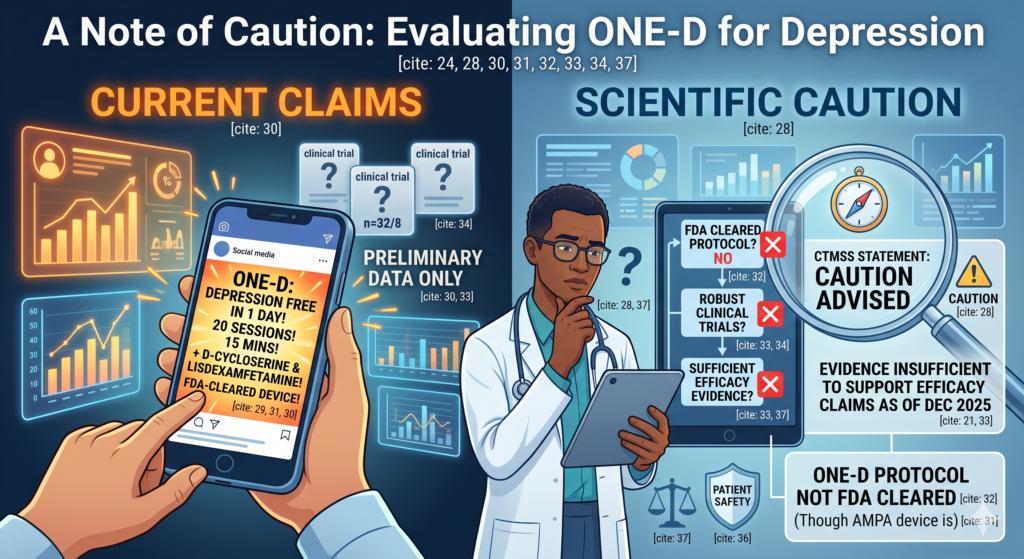
 Optimizing your mental health is a journey often paved with new technologies and promising protocols. One such advertised method, Optimized, Neuroplasticity-Enhanced techniques in Depression (ONE-DAY TMS), has garnered attention for its compressed timeline and combined approach. However, the Clinical Transcranial Magnetic Stimulation Society (CTMSS), dedicated to evidence-based practice, has recently issued a statement advising caution regarding current claims about its efficacy.
What is ONE-DAY TMS?
ONE-DAY is a specific accelerated Transcranial Magnetic Stimulation (TMS) protocol. It involves a single-day treatment regimen consisting of twenty sessions of 600-pulses intermittent theta burst stimulation. In addition to the stimulation, patients are administered specific oral medications—125 mg of d-cycloserine and 20 mg of lisdexamphetamine—in the morning prior to the treatment sessions.
While single-day and medication-assisted TMS protocols hold significant potential for establishing clinical efficacy in the future, it is crucial to understand the state of the evidence right now.
Understanding the Levels of Evidence
The CTMSS clinical standards committee and Board of Directors clarified that not all data is sufficient to recommend a clinical treatment or make efficacy claims in direct-to-consumer advertising. According to their statement, claims should not be based solely on:
- Pre-clinical data, including animal data, in-vitro, computational, or modeling data.
- Theoretical papers exploring possible treatment mechanisms.
- Non-published, non-peer-reviewed reports.
- Retrospective chart reviews or preliminary open-label data.
These types of data do not meet the threshold necessary to endorse an intervention for clinical use.
The Current State of ONE-DAY Evidence
The primary concern regarding ONE-DAY is that various clinics are making broad claims about its effectiveness without clearly stating that the supporting evidence is only very preliminary.
As of December 2025, the peer-reviewed evidence for ONE-DAY consists of One journal article and One abstract.
Both of these sources are retrospective case series. One examined 32 participants across two private clinics (Vaughn 2024), and the other included only 8 participants from a single primary care office (Nanos 2025).
Typically, a retrospective case series is viewed as a preliminary finding that requires follow-up with more rigorous studies. The current low level of evidence is not sufficient to support efficacy or to recommend ONE-DAY over established, evidence-based approaches.
FDA Clearance vs. Protocol Approval
It is important to differentiate between device clearance and protocol approval. The AMPA TMS device utilized to deliver the ONE-DAY protocol is FDA cleared through the 510(k) pathway for standard clinical treatment. However, the specific ONE-DAY protocol itself has not received FDA clearance.
Patient Guidance and Informed Decision-Making
If you are considering ONE-DAY TMS, it is essential to have a transparent conversation with your doctor. Ethical guidelines and the CTMSS strongly recommend:
- Clinics advertising ONE-DAY must be transparent in all patient communications regarding its low level of evidence and its off-label nature.
- Patients should be provided with evidence-based education materials that clearly explain the proposed treatment’s off-label status.
- Information must detail the current state of knowledge regarding risks and benefits.
- Patients need to receive a clear statement that ONE-DAY has not been approved or cleared for the specific condition(s) for which it is being offered.
We would add that ONE-DAY TMS is not covered by insurance and standard TMS is covered by most insurers.
At this stage, while future research may prove different, the available data does not meet the necessary threshold to recommend ONE-DAY as a clinical treatment. Choosing evidence-based care is paramount, and understanding the strength of the data behind any advertised treatment is the first step